
Stop Contemplating so Hard
It might make your life better.

Here’s a provocative question: what if all the self-investigations you do in pursuit of better mental health actually make things worse?
Constant journalling. Regular therapy sessions. Thinking deeply about your motivations and your trauma. Reading self-help books and listening to podcasts in search of solutions to your deepest psychological problems.
I’ve been doing all of the above doggedly for many years.
Until recently, I believed wholeheartedly that this work has improved my life and continues to do so.
But now I’m not so sure.
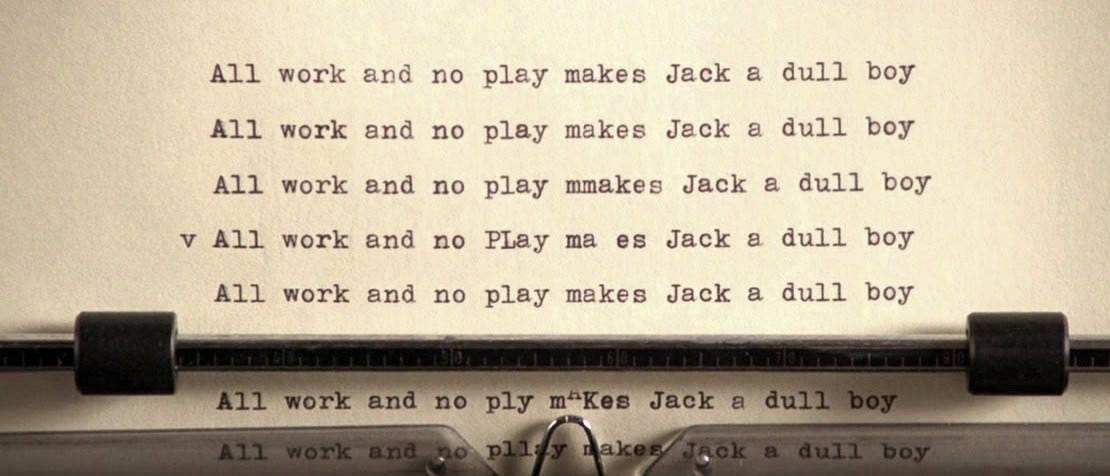
All work and no play makes Jack a dull boy.
Every New Year, I have a habit of revisiting my journal entries from the previous 12 months, looking for a sense of what happened and what it meant.
This might sound like a quick task, but generally, I write at least one digital page of journal per day, meaning I’m looking at the world’s most boring novel — 400+ pages of me pouring out my miseries and doubts into the digital ether.
Every time I do the exercise, I notice something: I am repeating myself constantly.
When I look back at journals from previous years, I see the same thing. 2011? Same fears, same pain, same worries, same complaints. 2014? Yep. 2022? Mmm-hmm.
At one level this is just depressing. The thinking behind spending so much time investigating my inner life was, “do enough of it and you’ll learn to be happier.” So far, no dice.
The other day, though, I saw another possibility: what if the repetitive nature of my journal entries wasn’t simply a matter of me failing to change over time? What if the journalling itself was actually causing me to stay the same?
Rewriting the self.
My theory is that my journal entries are serving as a kind of reiteration of the narrative I’ve built for myself.
It goes something like this:
I’m anxiously attached
I have trouble with boundaries
I’m a people pleaser
I’m good at starting things, but not finishing them
Conflict terrifies me
I’m still just a scared kid in an adult body
These are all beliefs or understandings that were hard-won through self-examination, through looking at the experiences and insights of hundreds of other people and seeing which ones resonated with me.
I don’t think any of them is wrong, exactly. What I am coming to see, though, is that they are not comprehensive.
The list above may be an accurate accounting of some of my tendencies, but it is not a life sentence or a set of firm lines within which I must play or else.
Every time I write another journal entry or have another therapy session bemoaning my inability to have difficult conversations or risk upsetting other people, I am rewriting the story into my mind and body.
The next time I try to behave differently, the narrative that I can’t is right there waiting, freshly rewritten, to prevent me from doing so.
We are what we pay attention to.
“You become what you give your attention to. If you yourself don’t choose what thoughts and images you expose yourself to, someone else will.” — Epictetus
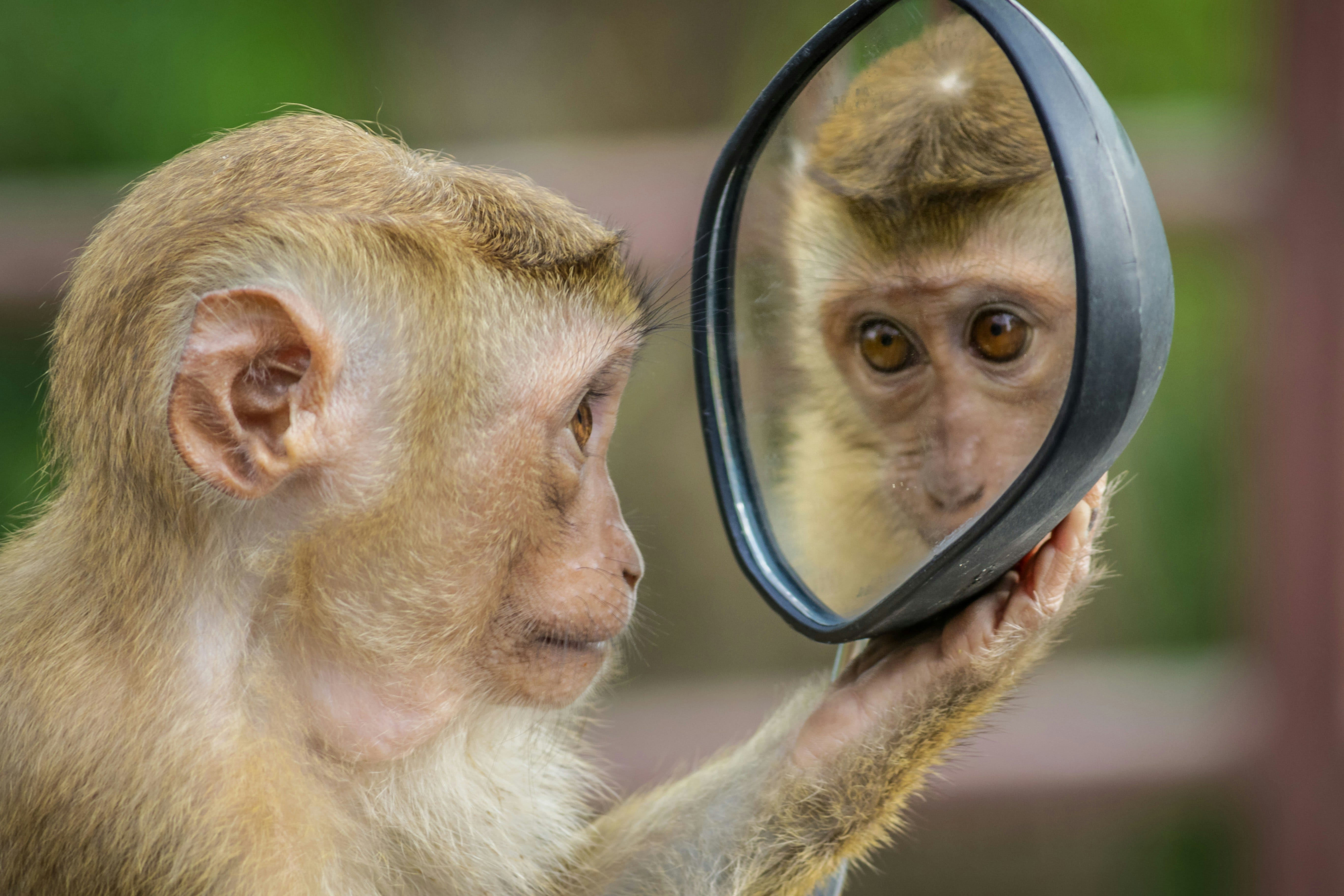
See that monkey looking in the mirror up at the top of the post? Maybe it’s okay if he becomes even more of a monkey by paying attention to his own reflection.
He is a literal monkey, right? (To be honest, I don’t actually know if he’s a monkey — zoologists, please weigh in.)
The trouble is, though, if he spends too much time looking in the mirror, he’ll start to ignore all the other things he could do, and be, and achieve.
He won’t become more like his true self by becoming obsessed with his own reflection.
My true self escapes all definitions I may try to put on it.
The list above — anxious, people pleaser, conflict-averse, etc. — may cover some parts of who I am, but by focusing mercilessly on those aspects of myself, I’ve let them overtake the fuller truth of me.
It’s as if I can no longer see beyond the frame of the mirror.
So pay attention better.
If I’m right that all this self-examination isn’t good for me, what’s the alternative?
I don’t think it’s “ignore your inner life and buy a giant truck and maybe a snowmobile” (although that might be fun).
Instead, I’m experimenting with paying closer attention to things other than myself.
I’m doing my best to notice what’s happening in the moment — to singletask rather than multitasking; to pause and really see and hear and smell and touch and taste the moment.
I’m learning about somatic experiencing (which, yes, may be more self-help, but focused on bodily sensation rather than mental focus on what’s wrong with me).
I’m using my journal to write down profound things I encounter in conversation or when reading, rather than as a place to list and examine my failings and strengths in an effort to pin myself down.
I’ve decided to work less on deep contemplation of the self and more on sitting quietly in a room alone.
Life is not a problem to be solved, but a reality to be experienced. - Søren Kierkegaard
I don’t think my “less journalling, more boredom” approach is going to lead me to some promised land of true self-actualization.
If that promised land exists, I’d love to visit it, but I’m pretty sure that’s not how this works.
What I hope for from this experiment is a little more freedom and flexibility in my life.
Rather than contemplating my own reflection so intently that I become frozen, I want to look outward at the beauty of everything: my friends, my family, other people, nature, the world as a whole.
Reality is infinitely fascinating and changeable. Maybe the same can be said of each one of us. My journal may not believe it, but I do.